
Quantitative linguistics (QL) is my passion since I discovered it with Ramon Ferrer-i-Cancho.
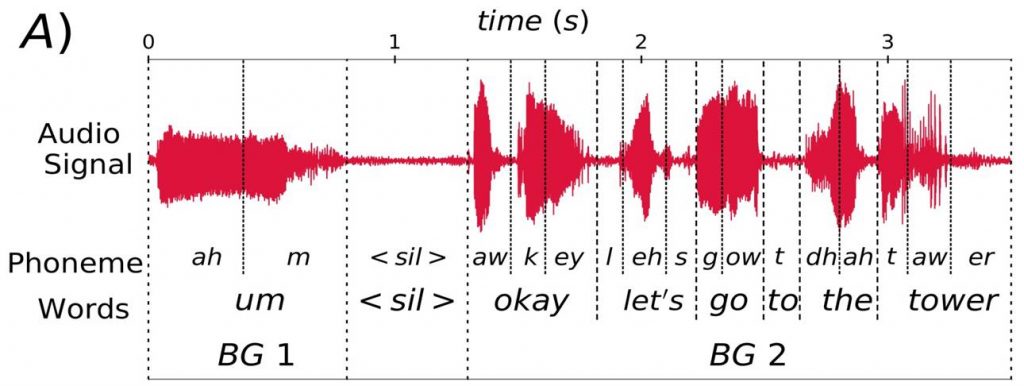
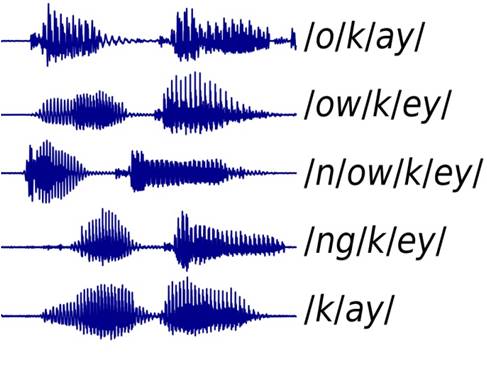
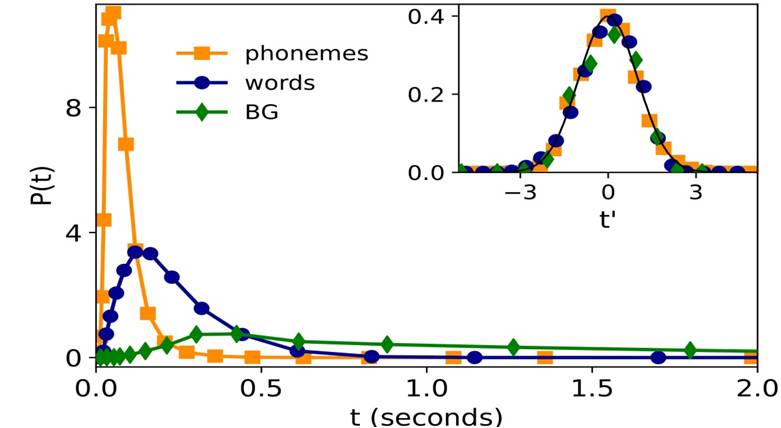
QL tries to investigate the language and communication systems from a mathematical and physical perspective: Can we find linguistic laws, analogously to physical laws? Sure!
Since I started studying linguistics in 1997 I always thought that science should enter fully into the study of language, at that time still dominated by pseudoscientific approaches…
“Qualitative linguistics searches for rules and enumerates the exceptions, quantitative linguistics searches for models of phenomena and tests the models, just as in physics. In quantitative linguistics one gets deeper and is ready to abandon a falsified hypothesis; in qualitative linguistics one adheres to a “school” and follows the prescriptions just as in a religion. Projects are accepted only if they are in line with the dominant school – represented by the members of the commissions.” Gabriel Altmann (1931-2020), in Glottometrics 33 (2016), p. 32. Editorial Glotto 33, 2016 (iqla.org)
The birth of Optical Linguistics! (FisEs Conference 2026, Tarragona)
The influence of physics on biological scaling laws in communication systems emerges from optimization principles that constrain how energy, matter, and information are distributed across living systems. In this work, we propose a unified framework for the investigation of linguistic-law analogues in non-biological physical systems, with a particular focus on photonic neurons operating under optical feedback. Building upon prior research on the physical underpinnings of linguistic regularities in human speech and recent advances in the multiscale dynamics of photonic neuromorphic devices, we introduce the concept of optical words or photowords as discrete, symbol-like units derived from continuous optical intensity time series. Analogously to human languages, we defined photonemes as the constituents of these photowords (see poster below).
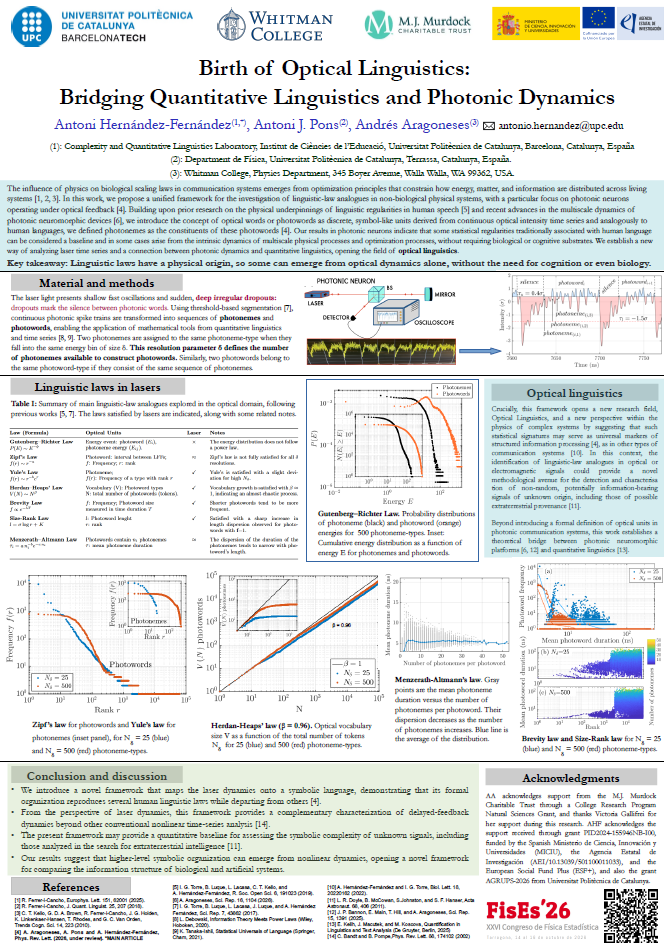
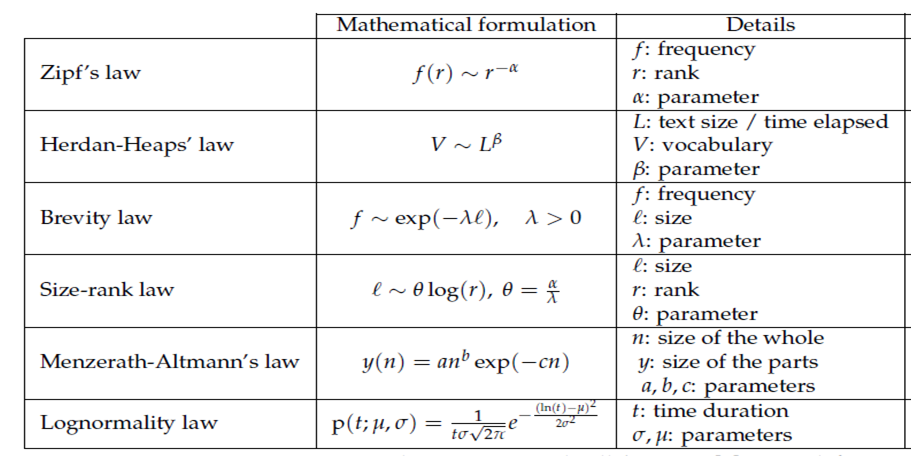
Using threshold-based segmentation, continuous photonic spike trains are transformed into these sequences of photonemes and photowords, enabling the application of mathematical tools from quantitative linguistics and time series. We then examine the emergence of well-known linguistic laws—including Zipf’s law, the Herdan–Heaps law, the Brevity law, and the Menzerath–Altmann law— within these purely physical optical systems. Our results in photonic neurons indicate that some statistical regularities traditionally associated with human language can be considered a baseline and in some cases arise from the intrinsic dynamics of multiscale physical processes, without requiring biological or cognitive substrates. Crucially, this framework opens a new research field, Optical Linguistics, and a new perspective within complex systems physics by suggesting that such statistical signatures may serve as universal markers of structured information processing, as in other types of communication systems.